Zero to Hired: from a blank GitHub to an interview-ready portfolio in six months.
Instant access · 7-day refund
The problem.
The gap
Every company building with AI asks the same question: how did you know it worked? Here’s what they find when they open your GitHub.
- main.py
- model.pkl
- README.md
- requirements.txt
$ git log --oneline
a3f9c21 final version
- “I’ll add tests later”nothing proves it runs
- “the README explains it”README says “TODO”
- “five projects show range”zero depth, nothing to defend for ten minutes straight
- “one clean commit is fine”no history, no proof you built it yourself
Zero to Hired replaces this: 2-3 deep projects, real git history, numbers you can defend.
What's inside.
Inside
52 pages, five parts. The literal list first, then what each one actually does.
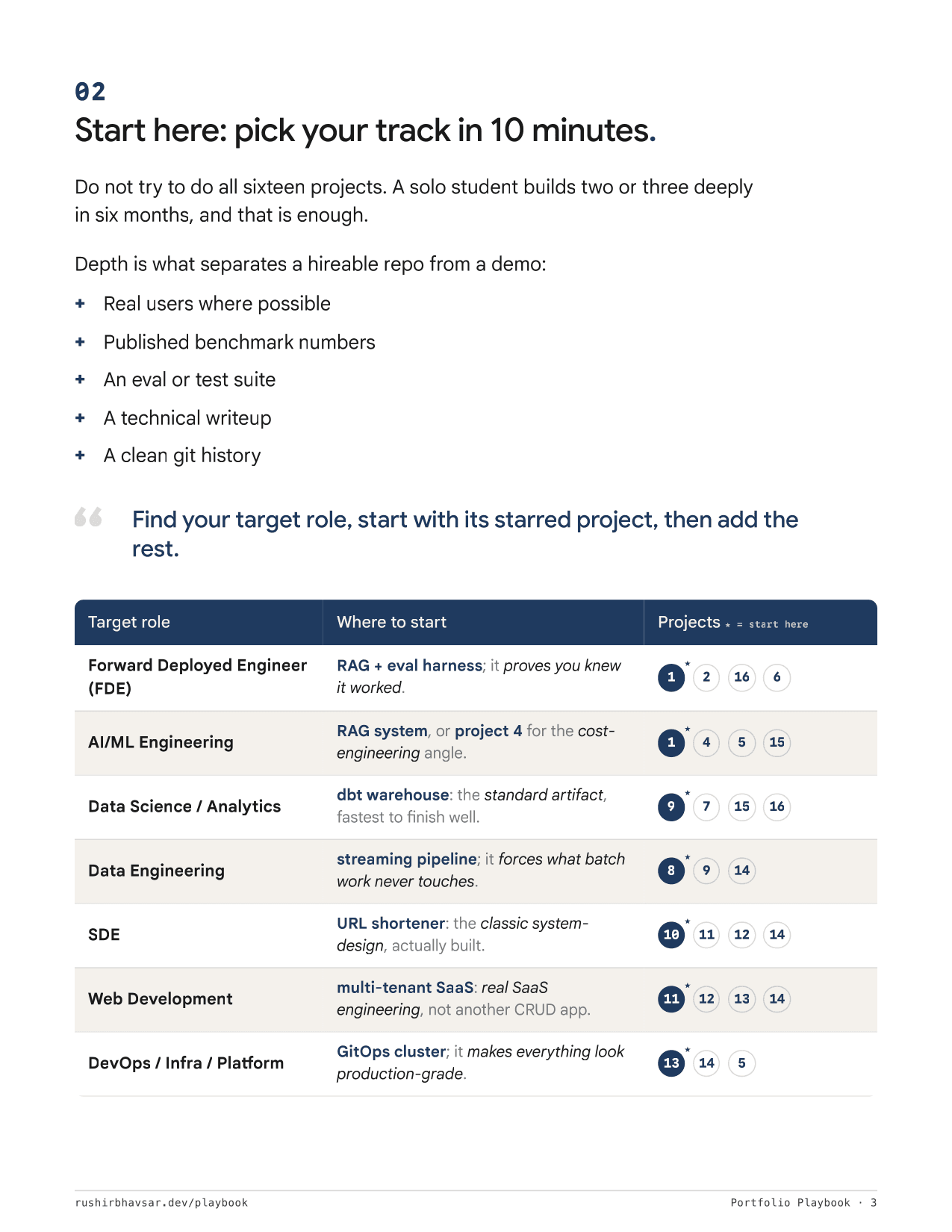
- Pick-your-track guide3 tracks, mapped to real roles
- 16 project specs30 of the 52 pages
- Free-tier stack guidecommercial-grade tiers, and their limits
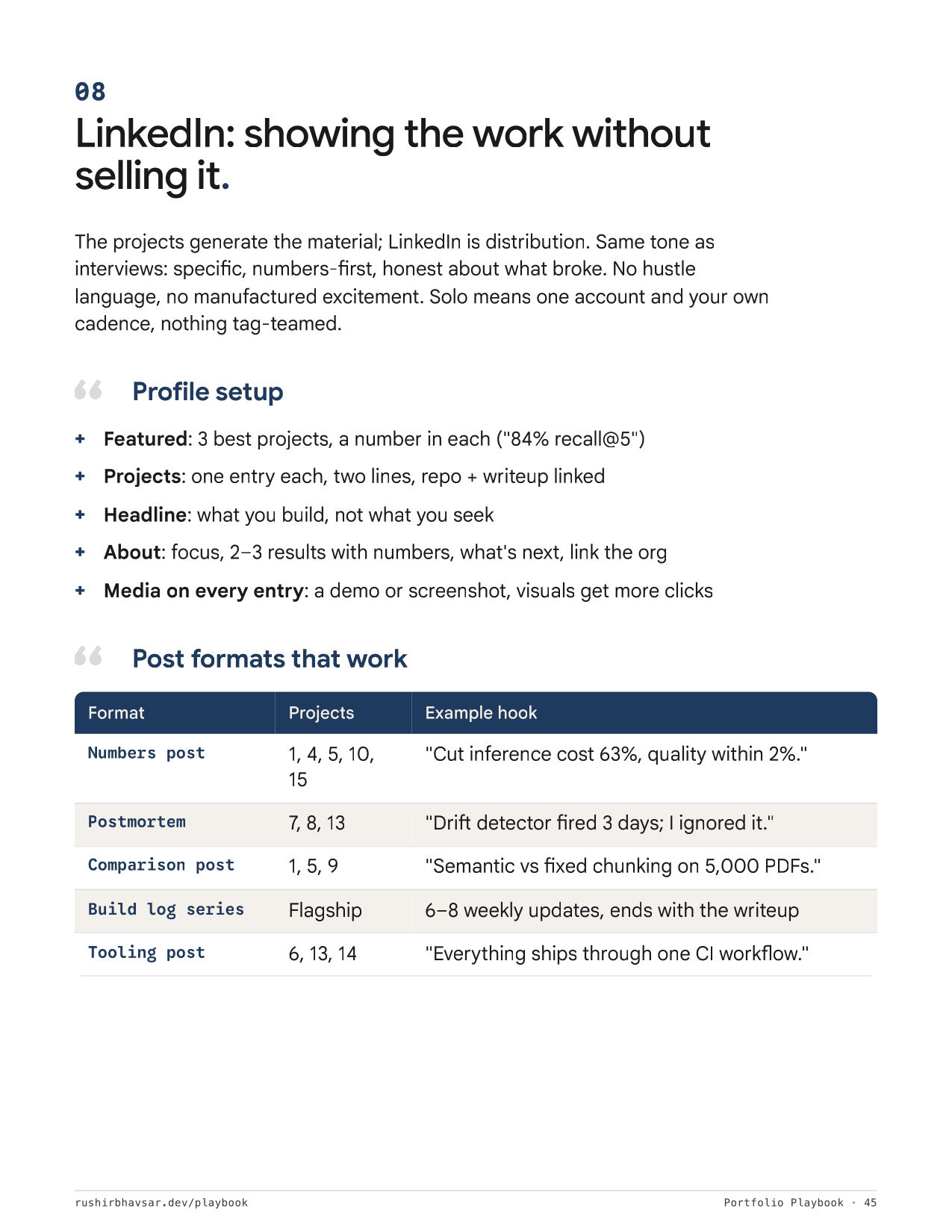
- Three playbooksgit, DevOps, LinkedIn
- Companion zipfile[Core]skeletons, tracker, bullet bank, Discord
Forward-Deployed Engineer
- Approval-gated support agent
- Customer data integration service
AI-ML Engineer
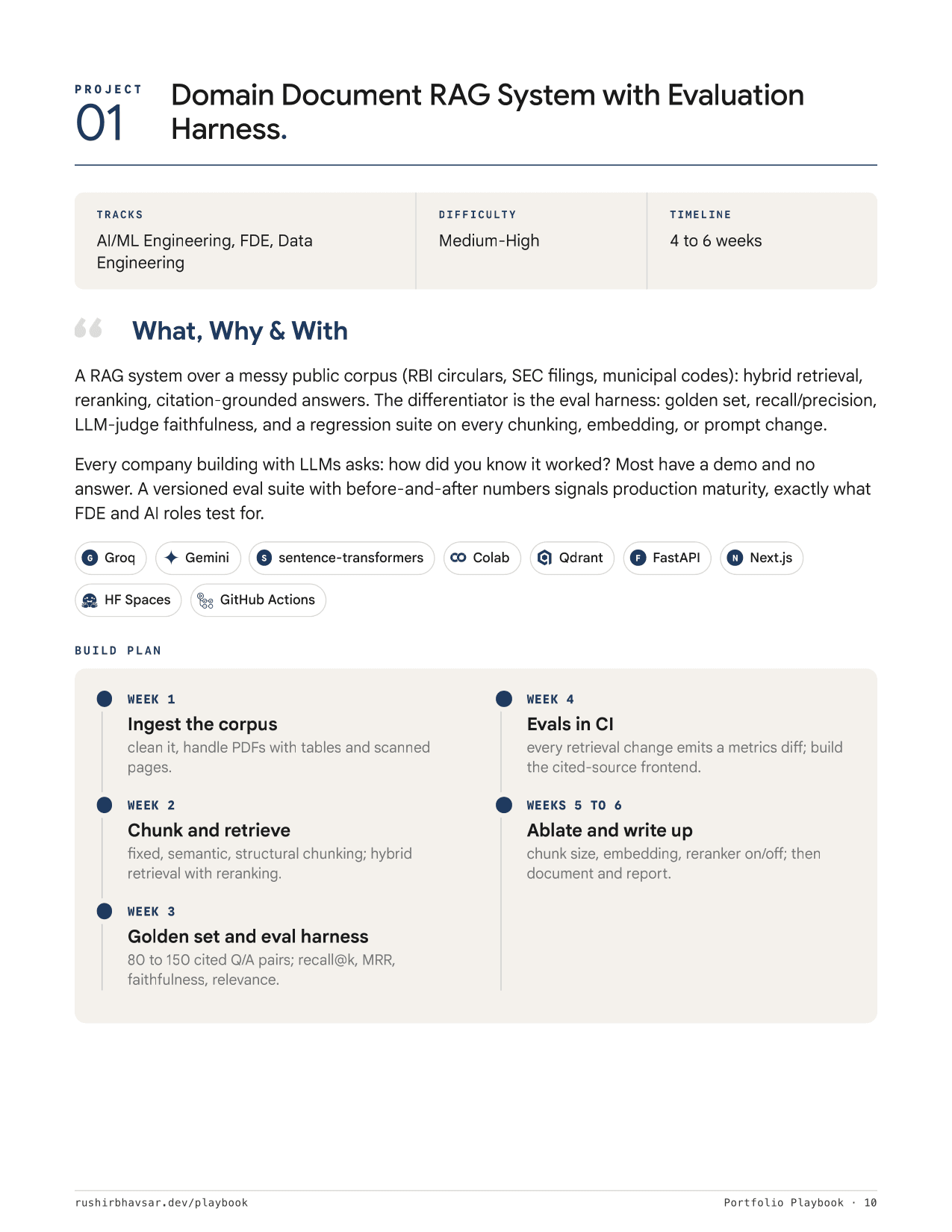
- RAG system with an eval harness
- Drift-monitored retraining pipeline
Data Engineer
- Real-time clickstream pipeline
- Warehouse model + analytics API
What to build
The scope, and the hiring signal it sends.
The build plan
Week by week, to a working system.
The interview
The questions this project prepares you to answer.
The bullets
What goes on the resume when it ships.
The $0 stack
- Groqinference
- GeminiLLM + embeddings
- ColabGPU
- Oracle Cloudalways-free ARM
- SupabasePostgres + auth
- repo-skeleton/
- README.md the one a recruiter reads first
- design-doc.md decisions, tradeoffs, numbers
- .github/workflows/ci.yml tests green on every push
- CLAUDE.md agent context, preconfigured
- progress-tracker.md 6 months, week by week
- resume-bullet-bank.md phrasing per project
- discord-invite.url feedback and accountability
- GitHub
- Claude
- Discord
Why trust this.
Proof
You are standing in it. My portfolio is what this method produces, so every claim below is something you can go and check right now.
- Seven case studiesRole-targeted projects, each written up so that even a private repo still reads as credible to someone who cannot see the code.
- yelp-ml-platform (opens in new tab)Public repo. 7M reviews, ETL at ~462K rows/sec, 86.3% sentiment accuracy, p99 0.11 ms serving. Every headline number has a committed benchmark output behind it.
- cohors (opens in new tab)Open source. Read the commit history instead of taking my word about commit discipline.
No hustle, no inflated numbers. The playbook tells you to publish only numbers you can defend for ten minutes, because one hard question in the comments undoes months of credibility. I hold myself to the same rule here.
Pricing.
Core
$50$45
One payment · lifetime updates · 10% launch discount, pre-applied
- All 16 project specs, with week-by-week build plans
- The pick-your-track guide
- The free-tier stack guide
- git, DevOps and LinkedIn playbooks
- Companion zip: repo skeletons, tracker, Resume Bullet Bank
- Buyers' Discord
- Lifetime updates
Launch price $45 (10% off), then $50. A live cohort opens later; Core buyers get it at a discount, and everything in Core carries over.
FAQ.
Common questions
What do I get?
A 52-page PDF and the companion zip. Gumroad delivers both instantly at checkout.
Do I need a GPU or a budget?
No. Every project runs on free tiers.
Solo, or do I need a partner?
Solo. An appendix covers the two-person workflow if you find one.
Is this just a list of ideas?
No. Week-by-week plans, repo skeletons, a tracker, and the git and LinkedIn playbooks.
I'm not in the US.
Fine, none of it is US-specific. Price is USD; your card converts at checkout.
Is there a discount?
The $45 launch price is 10% off and already applied. After that it's $50.
Will it go stale?
Lifetime updates. The stack moves, so does the playbook.
Guarantee.
7 days
If the playbook doesn’t hand you a plan you are actually excited to start, you get your money back. No form, no justification, no “what didn’t you like”.
- From your Gumroad receiptThe refund request is a button in the emailed receipt. You never have to talk to me.
- Email mebhavsarrushir@gmail.com. One line is enough; I refund it and we are done.
Six months from now your GitHub either proves something, or it doesn’t.
It is the same six months either way. The only question is whether you spend them building the right three things.
Instant access · 7-day refund